Car Accident Lawyer Longmont: What to Do After a Crash and How to Choose One
Last updated
This guide covers the first hours after a collision in Longmont, Colorado, how to get the crash report, the state rules behind an injury claim, where a local case is filed, and how to compare car accident lawyers. Longmont has about 100,109 residents, according to the U.S. Census Bureau (2025).
Everything here is general information taken from Colorado statutes and official agency pages, checked November 2026. Major roads through Longmont include Ken Pratt Boulevard, Main Street, Hover Street and Ute Highway.
Right After a Crash in Longmont
Colorado law gives every driver in a collision a short list of duties.
- Stop at the scene or as close to it as you safely can. Leaving a crash that injures someone is a crime under C.R.S. 42-4-1601.
- Call 911 if anyone is hurt or a driver seems impaired. On a divided highway, vehicles that can still be driven safely should be moved off the road, under C.R.S. 42-4-1602(2).
- Give reasonable help to anyone injured, as C.R.S. 42-4-1603 requires, and exchange names, addresses and registration numbers with the other driver.
- Report the crash. C.R.S. 42-4-1606 requires a driver in a collision with injury, death or property damage to notify the nearest police authority right away.
- Take photos of the vehicles, plates, signals and injuries, and write down witness names.
See a doctor soon even if you feel fine, since some injuries take days to show.
Getting the Crash Report in Longmont
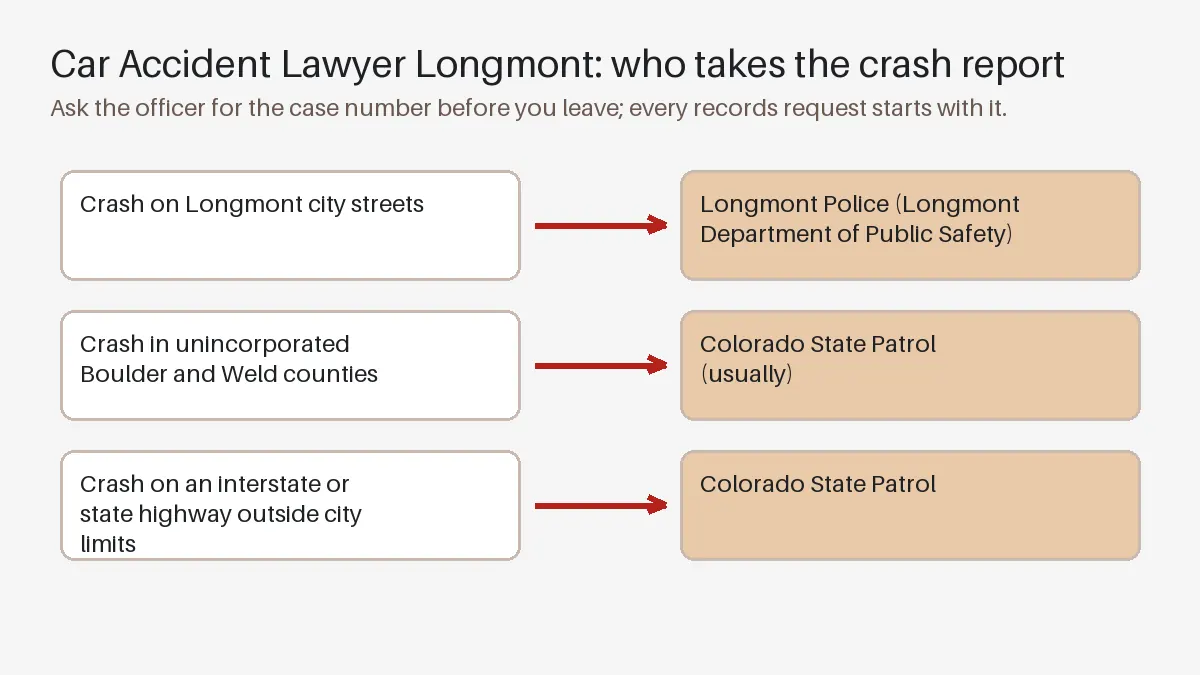
The agency that responded holds the report, so start with the case number the officer gave you.
- Crashes on city streets: the Longmont Police (Longmont Department of Public Safety) usually takes the report; copies are requested through its records page.
- Crashes in unincorporated Boulder and Weld counties: the Colorado State Patrol usually investigates traffic crashes, and the Boulder County Sheriff's Office keeps records for incidents its deputies handle.
- Interstates and state highways outside city limits are usually worked by the Colorado State Patrol, which explains its records process on its crash information page.
Colorado Rules That Shape a Claim
Colorado is an at-fault state, so the driver who caused a crash and that driver's insurer generally pay for the losses.
- Deadline: three years for most injury lawsuits arising from a motor vehicle crash, under C.R.S. 13-80-101(1)(n).
- Claims against a city, county or other public entity need written notice within 182 days of discovering the injury, under C.R.S. 24-10-109.
- Shared fault: under C.R.S. 13-21-111 your damages are reduced by your share of fault, and you recover nothing at 50 percent or more.
- Insurance: every Colorado policy must carry at least $25,000 per person, $50,000 per accident and $15,000 for property damage, under C.R.S. 10-4-620.
Where Longmont Car Crash Cases Are Filed
Injury lawsuits from Longmont are generally filed in the Boulder County Combined Court - Longmont, part of Colorado's 20th Judicial District, at 1035 Kimbark St, Longmont, CO 80501. Parts of Longmont lie in Weld County, where that county's district court applies. Most car crash claims settle without a trial.
Local Crash Data
23 people died in motor vehicle traffic crashes in Boulder County in 2024, according to the federal Fatality Analysis Reporting System. The figure covers the whole county and every type of road.
How to Choose a Car Accident Lawyer in Longmont
- Check the license in the Colorado attorney search run by the Office of Attorney Regulation Counsel.
- Ask how many motor vehicle cases the lawyer has handled and how many went to trial.
- Get any contingency fee in writing, as Rule 1.5(c) of the Colorado Rules of Professional Conduct requires, and ask whether costs come out before or after the fee.
- Be wary of anyone who contacts you uninvited soon after the crash. C.R.S. 13-93-111 bars soliciting an injured person within 30 days of the incident.